Spalart-Allmaras closure functions
The SA one-equation model evaluates a chain of nondimensional closure functions from the working variable \(\tilde\nu\) and the local strain/vorticity magnitude.
Core definitions
Modified strain
With \(r_s = \tilde\nu/(\kappa^2 d^2)\) (including Reynolds scaling in the solver) and \(\bar S = r_s f_{v2}\):
Wall destruction function
Optional trip function \(f_{t2}=c_{t3}\exp(-c_{t4}\chi^2)\).
Role of \(f_{v2}\) and the modified strain
Production in SA uses a modified strain rate (tilde S), not the raw vorticity (Omega) alone. First form the near-wall correction
Then
with standard limits (c_2=0.7), (c_3=0.9).
Physical role
(f_{v2}) couples the working-variable ratio (chi) back into the strain used for production, so near-wall damping is consistent with (f_{v1}) (eddy viscosity) rather than treating (Omega) as independent of (tildenu).
(bar S = r_s f_{v2}) vanishes at the wall with (tildenu) and grows with wall-distance scaling (1/d^2).
The limited branch prevents (tilde S) from becoming non-physical when (bar S) is strongly negative relative to (Omega) (implementation safeguard used widely in SA codes; see NASA TMR notes).
Theory curve for (f_{v2}(chi)) (standard (c_{v1}=7.1)):
CSV:
tools/verification/data/sa_fv2_chi_theory.csvPlot:
tools/verification/plot_sa_fv2.py
python tools/verification/plot_sa_fv2.py
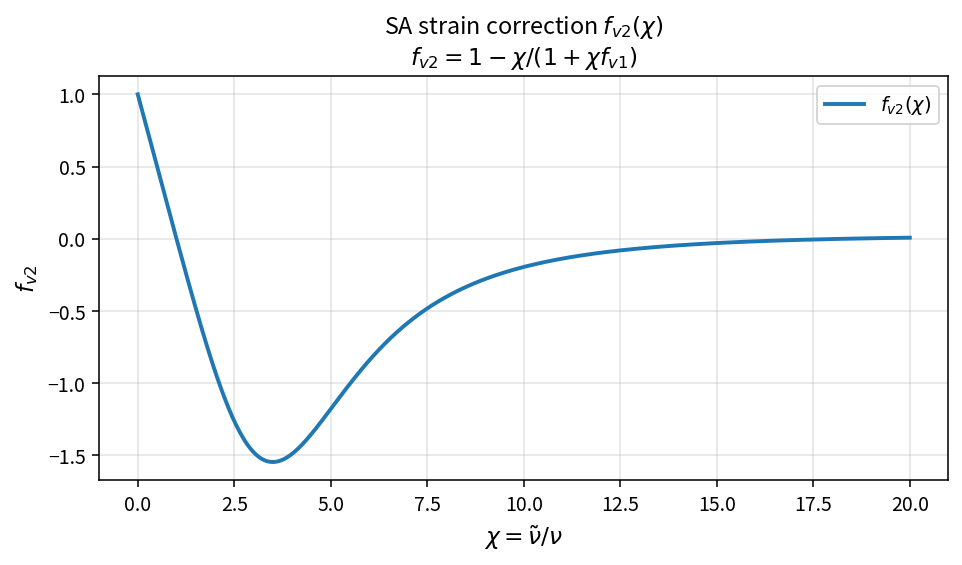
Proves: pure SaFv2 / SaModifiedStrainRate match closed form at
sampled points.
Does not prove: wall-distance field, full residual, or skin-friction match.
Role of the wall destruction function
The Spalart–Allmaras working-variable equation balances production of \(\tilde\nu\) against destruction near walls. The destruction term has the structure
where \(d\) is wall distance. Without a carefully shaped \(f_w\), a pure \((\tilde\nu/d)^2\) sink either under-damps in the outer layer or mis-calibrates the log layer.
Definition of the intermediate ratio
Qualitatively:
Near a solid wall (\(\tilde\nu\to 0\) or large \(\tilde S d^2\)): \(r\to 0\), hence \(f_w\to 0\). Destruction vanishes together with \(\tilde\nu\), which is consistent with a laminar sublayer.
Log layer calibration point: \(r=1\) yields \(f_w=1\). The constants are chosen so that the model recovers the standard logarithmic law with \(\kappa\approx 0.41\).
Outer / wake region (\(r>1\)): \(f_w>1\), so destruction is stronger than the bare \((\tilde\nu/d)^2\) term. That extra sink prevents an unrealistically thick turbulent viscosity away from the wall and is part of the original SA outer-layer calibration.
The auxiliary map \(g(r)=r+c_{w2}(r^6-r)\) is a monotone nonlinear stretch of \(r\) (with \(c_{w2}=0.3\)) before the smooth \(f_w(g)\) factor (with \(c_{w3}=2\)). The composition is smooth, \(C^1\)-friendly for Newton/LUSGS linearizations, and bounded for \(r\in[0,10]\).
Shape of \(f_w(r)\)
The theory curve (standard constants) starts at the origin, passes through \((1,1)\), then rises gradually toward an outer plateau as \(r\to 10\). Regeneratable data and figure:
CSV:
tools/verification/data/sa_fw_r_theory.csvPlot script:
tools/verification/plot_sa_fw.py
python tools/verification/plot_sa_fw.py
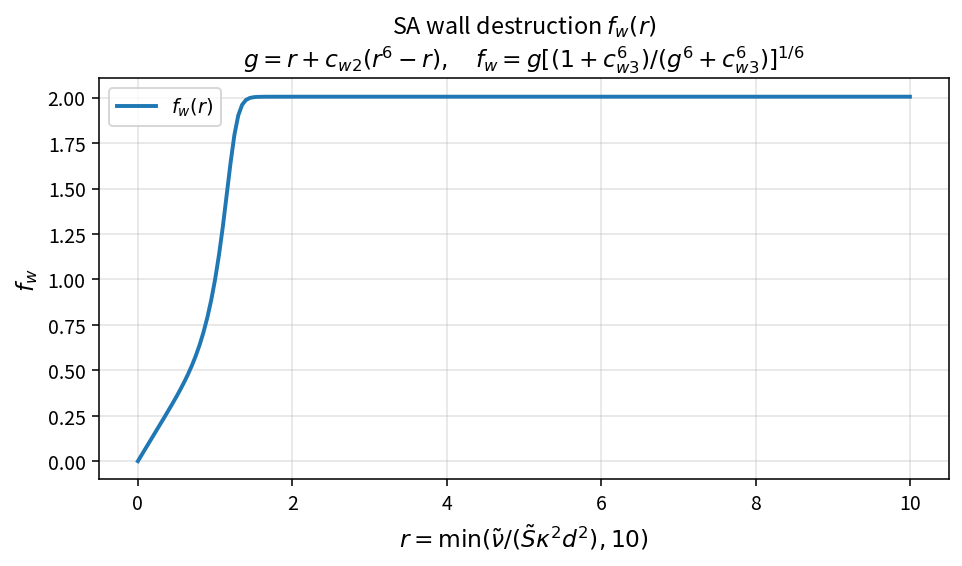
Proves (with pure API tests): algebra of SaG / SaFw matches the
published formula at sample points.
Does not prove: wall-distance field quality, full CalcSrcSa residual,
skin friction, or experimental agreement.
References
Spalart, P. R. and Allmaras, S. R. (1992/1994). A one-equation turbulence model for aerodynamic flows.
Allmaras, S. R., Johnson, F. T., Spalart, P. R. Modifications and clarifications for the implementation of the Spalart-Allmaras model.
NASA Turbulence Modeling Resource (SA equations and constants).
See
references.rstfor the citation policy and self-evolution loop.
Pure APIs: TurbSaPolicy.h. Tests: turb_sa_policy_test.
Wiring: TurbCom::CalcSrcSa.