Viscous face spectral radius (model 3)
Purpose
Model 3 is the cheapest viscous spectral placeholder:
Family overview: Viscous face spectral radius (overview).
Formula and rationale
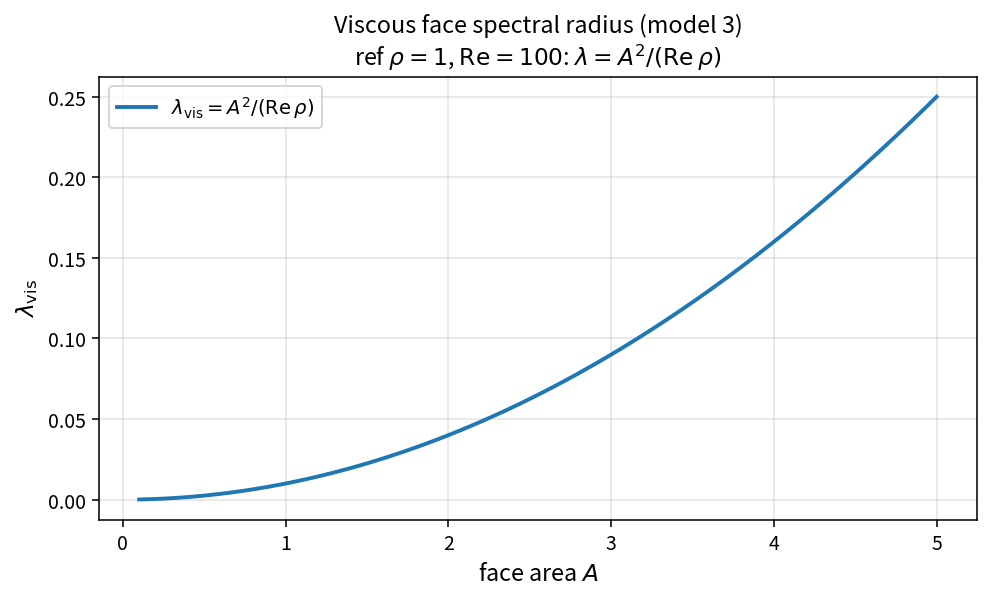
Only geometry (\(A\)), density, and Reynolds number enter. Dynamic viscosity is not explicit: viscous magnitude is assumed absorbed into the non-dimensional (mathrm{Re}) scaling. This is useful as a robust fallback or when a full (mu,mathrm{Pr}) field is unavailable.
It still scales as :math:`A^{2}), consistent with a (ksim A/V) diffusion argument, but without the (max(c_1,c_2)) structure of model 1.
Source map
ViscousFaceSpectralRadiusModel3inTimeStepPolicyExisting unit test:
TimeStepPolicy.ViscousFaceSpectralRadiusModel3IsArea2OverReRhoTheory table:
tools/verification/data/viscous_spectral_radius_model3_theory.csvContract Workbench id:
viscous_spectral_radius_model3
What this proves / does not prove
Proves: (A^{2}/(mathrm{Re}rho)) algebra matches the pure API.
Does not prove: adequacy for high-(mu_t) boundary layers (model 1 is preferred when viscosities are known).
References
Degenerate limit of area-squared viscous estimates when the diffusivity prefactor is absorbed into (mathrm{Re}) (engineering simplification; not a separate classical theorem).
Blazek (same time-step chapters) motivates including viscous spectral radii; model 3 is OneFLOW’s minimal realization of that requirement.
Family overview: Viscous face spectral radius (overview).